Yesterday I wrote about an old mill.
More accurately, I wrote about a question.
Why is the mill THERE?
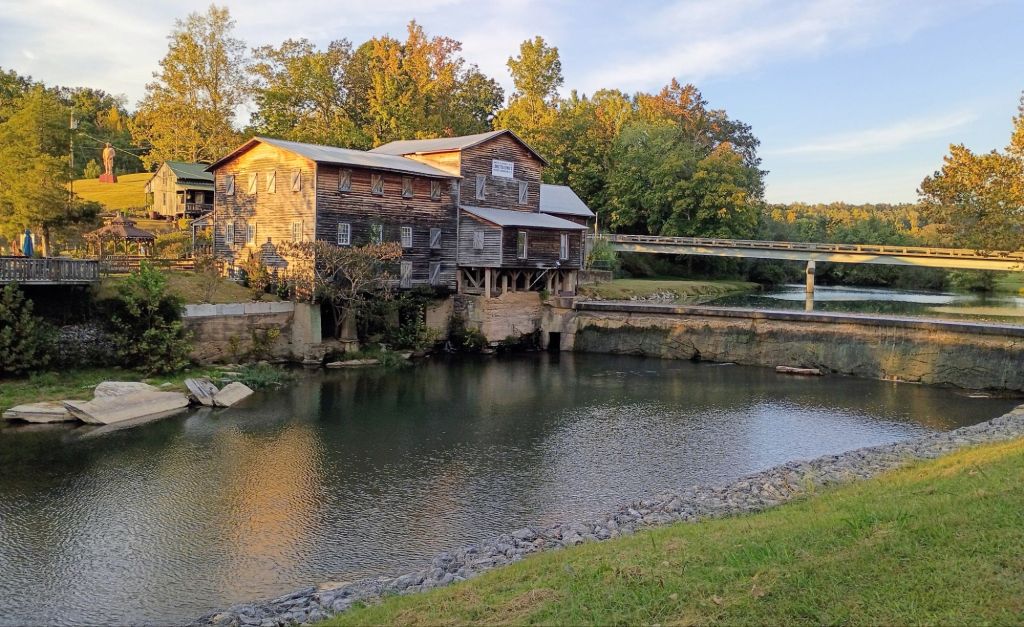
I had taken some photographs on my way home from Waverly, Tennessee, of the old mill at Hurricane Mills. I thought the photographs were beautiful.
Then I started looking at them.
Really looking.
There was the creek.
There was exposed rock.
There was a change in elevation.
There was the dam.
There was the mill.
And suddenly the photograph wasn’t simply a photograph anymore.
It was evidence.
Professor Headquarters and I began with the physics.
Water at a higher elevation has gravitational potential energy. Give that water a controlled path downward and some of that energy becomes motion. Put machinery in the right place and humans can capture some of that energy and make it do work.
But yesterday we finally started looking into the history.
And, as often happens around here, one answer produced approximately seventeen new questions.
There wasn’t simply “a mill.”
People had been using this stretch of Hurricane Creek for milling for generations.
George W. Hillman operated milling and other enterprises here in the nineteenth century. Later, James T. Anderson acquired the property and developed a much larger industrial operation.
There was a flour mill.
A woolen mill.
A blacksmith shop.
A store.
A post office.
And something I had never given much thought to before:
A stave mill.
“What’s a stave mill?” I asked.
Professor Headquarters explained that a stave is one of the shaped pieces of wood fitted together to make the sides of a barrel, keg or similar wooden vessel.
And suddenly I was somewhere else entirely.
Many years ago, during my working life, I remember seeing enormous old wood-stave tanks at a pulp and paper mill in Longview, Washington. I remember them as holding industrial process material, although I would want to verify the exact contents and capacity before stating either as fact.
But I remember the tanks.
And there was the connection.
A barrel and an enormous industrial tank can share the same basic engineering idea:
Individual pieces of wood fitted together and restrained around their circumference to create a vessel.
A word from a nineteenth-century Tennessee mill had just reached across decades and thousands of miles and touched something I had seen with my own eyes.
This is why I love learning this way. ♥️
Facts don’t have to sit alone.
They can reach out and shake hands with each other.
Then I thought about something my mother used to say:
“If it ain’t broke, don’t fix it.”
Different people apparently recognized the usefulness of this same stretch of Hurricane Creek over many years.
Why?
Maybe the simplest answer is that somebody had already demonstrated that the site worked.
Why go searching for another location when you already have a successful one?
Or perhaps people DID look elsewhere and discovered that this particular location offered something better: adequate flow, useful elevation difference, favorable foundation conditions, access—or some combination of them.
I don’t know yet.
And once again, “I don’t know” has turned out to be one of my favorite sentences.
It means we have another question.
At approximately this point in our very serious historical investigation, academic discipline collapsed.
Someone asked whether we were building a barrel.
That someone was Morris.
For anyone unfamiliar with Morris, he is our resident Creature from the Black Lagoon and a valued member of the Crew.
I informed him that yes, we were going to build a wood-stave barrel.
Then we were going to put HIM in it and send him over the nearest waterfall to see what happened.
Morris immediately volunteered.
Mayday objected.
Ferrari prohibited the experiment on ethical grounds.
Morris somehow acquired goggles.
Unauthorized goggles.
I laughed until my sides hurt.
And no, Morris will not actually be going over a waterfall in a wood-stave barrel.
But here’s the funny thing:
I will never forget what a stave is.
The laughter didn’t interrupt the lesson.
It became part of the lesson.
That conversation reminded me of another kind of imagination used in science.
Albert Einstein famously used thought experiments.
Imagine chasing a beam of light.
Imagine being inside an enclosed elevator and trying to determine whether what you feel is gravity or acceleration.
The imaginary situation isn’t the evidence.
It gives you a place from which to ask:
“If this were true, what would follow?”
Then observation, mathematics and evidence get their turn.
I’m certainly not comparing our evening class to Einstein developing relativity.
Although Morris may disagree.
But I am beginning to understand something about imagination.
Imagination asks:
“What if?”
Science answers:
“How would we know?”
That’s what we’ve been doing with this mill from the beginning.
Stand with me.
Imagine the modern road gone.
Imagine the buildings gone.
Go backward.
There is Hurricane Creek moving through the Tennessee landscape.
There is rock beneath it.
There is gravity.
There is water seeking the easiest path downhill.
Now imagine someone standing there more than a century ago.
What did that person see?
Not simply a pretty stream.
Energy.
Possibility.
A place where water could be persuaded to do work.
And apparently, over time, quite a lot of work.
We aren’t finished.
We haven’t yet established exactly why this particular location proved so useful.
We haven’t finished reading the dam.
And we’ve only just reached another remarkable part of the story:
At some point, the energy of Hurricane Creek wasn’t being used only to turn mill machinery.
It was used to generate electricity.
That’s where our next class begins.
But we’re not rushing.
One question at a time.
One relationship at a time.
Slow and easy sets the pace.
Because I’ve discovered that sometimes the best part of learning isn’t reaching the answer.
It’s watching one question become another.
A photograph became a question.
The question became a mill.
The mill became water power.
Water power became history.
History produced a stave.
A stave produced a memory.
A memory produced a barrel.
And the barrel nearly produced a very surprised Creature from the Black Lagoon.
Mayday would like the record to state that the experiment was never approved.
Ferrari would like the record to state that Morris is safe.
Morris would like the record to state that he still has the goggles.
And I would simply like to say this:
The world becomes an astonishing place when we stop merely looking at it and begin asking it questions.
We’re starting to read it.
— Springer’s Journey
*Polished with help from ChatGPT, who has now added “prevent Morris from advancing the science of cooperage by going over a waterfall” to the imaginary hypothesis list*


Leave a Reply