Something has changed since I came to Tennessee.
I am beginning to pay attention differently.
Not long ago, I was moving constantly. Where will I sleep tonight? Where am I going tomorrow? How far can Cora and I comfortably drive? What does the weather look like? Where is the next campground?
Now I have a little log cabin that I call home. I have work. I have days off. I have people whose names I know.
And because I am no longer moving all the time, I am beginning to notice the things that are moving around me.
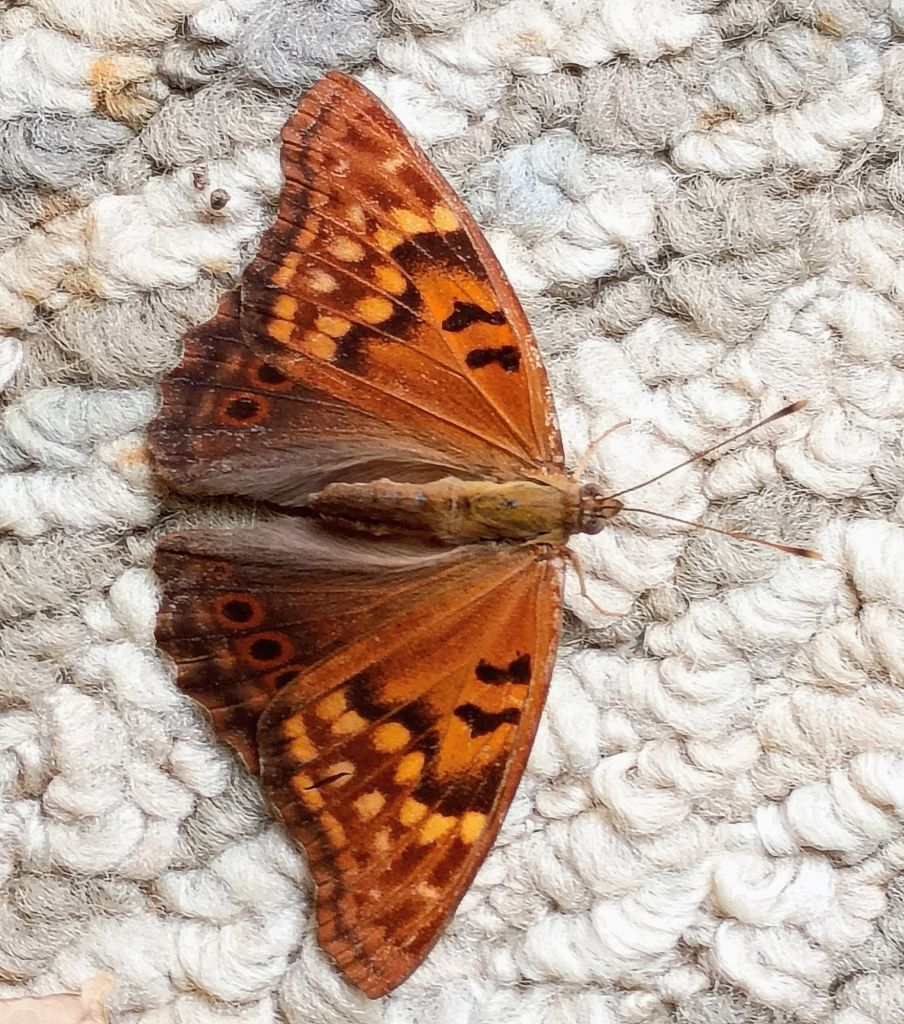
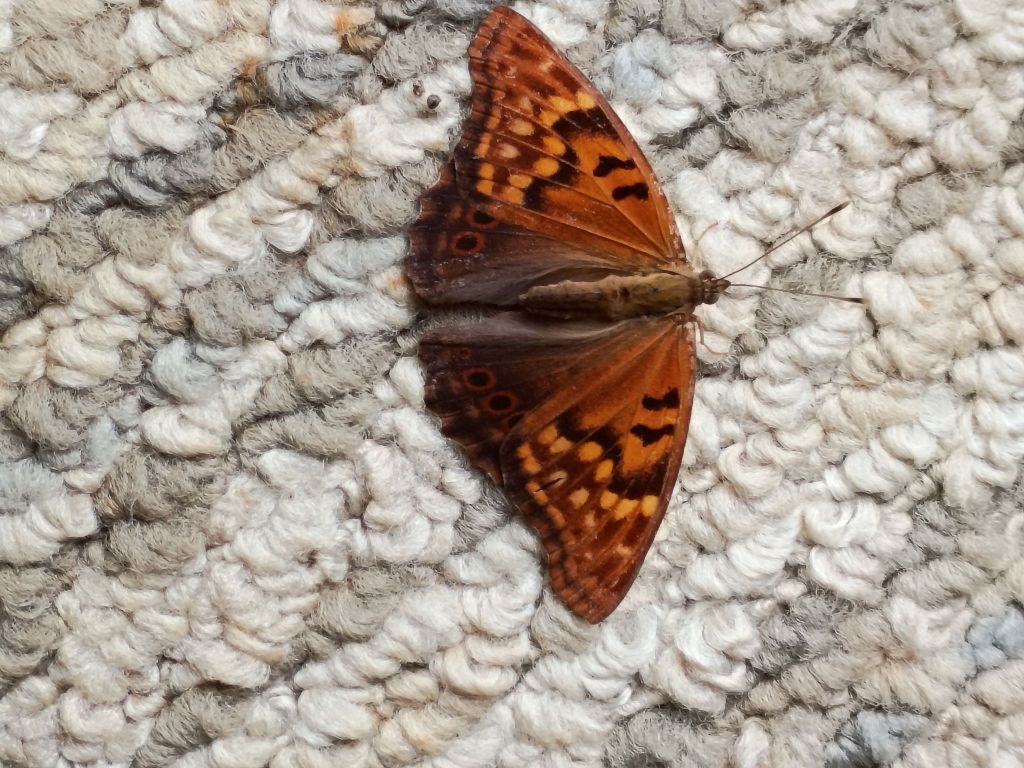
Yesterday there was a butterfly on the rug outside.
At first I thought she was a moth. She had arrived sometime during the night, and I watched her moving her wings before she eventually folded them upright and remained there.
By late morning, she had opened them again.
Professor Headquarters and I started doing what we do.
We observed.
We asked questions.
We tried very hard not to turn an observation into a conclusion.
The clubbed antennae told us I was probably looking at a butterfly rather than a moth. Her markings suggested that she may have been a hackberry emperor (Asterocampa celtis), although the photographs weren’t enough to make a certain species identification.
So we left it at that.
Strong candidate.
There is something I love about those two words.
Science doesn’t require me to know everything I am looking at. It only asks me to be honest about what I know, what I don’t know, and what the evidence allows me to say.
She stayed on that rug for hours.
As the morning warmed, she spread her wings. Perhaps she was basking, using the warmth of the sun to raise her body temperature enough for flight. Butterflies are ectothermic, so that was a reasonable hypothesis.
But again:
Perhaps.
We watched.
And eventually, I got to see her fly away.
I wish I could tell you it was a magnificent, graceful departure.
It was not. 😂
She sort of fluttered all over the place as though somebody had neglected to explain to her that butterflies are supposed to look elegant.
But she flew.
And I was ridiculously happy to see it.
Then last night, after days of clouds and trees conspiring against me, I finally saw the Moon.
I actually drove a little way up the road so I could get a clear view of her.
A few weeks ago I probably would have looked up and said, There’s the Moon.
Last night I looked at her and knew something more.
She looked full.
But she wasn’t quite.
She was waxing gibbous—more than half illuminated and still growing toward full.
Tonight, for one instantaneous moment, she will be full. Then, without stopping or waiting for the calendar to change dates, she will continue along her orbit and become waning gibbous.
I am learning that the Moon doesn’t belong to the night.
The Moon belongs to her orbit.
This morning another little piece of Tennessee presented itself.
A family is staying in the cabin across from mine. They arrived after dark last night with three children, so I told them I worked here, got their key, opened their cabin, and turned on the lights for them.
This morning the children were outside.
I showed them the Merlin bird-identification app.
They were fascinated. ♥️
And that made me smile.
Because perhaps science doesn’t always begin in a classroom.
Sometimes it begins with a butterfly sitting on a rug.
Sometimes it begins with three children listening to a bird.
Sometimes it begins with a woman driving up a Tennessee road because she is absolutely determined to find the Moon.
And sometimes it begins with a question:
What does this tell me?
I have spent much of Springer’s Journey learning to ask another one:
How did you get here?
A rock.
A river.
A butterfly.
The Moon.
Me.
I don’t have to know all the answers.
I only have to pay attention.
We’re starting to read it.
Polished with help from ChatGPT, who understands Mayday Murphy far better than any reasonable being should.


Leave a comment